

On this page
Editorial Information
- Tax year:
- 2026
- Reviewed by:
- Okeyma Armstrong, ArmStrong Tax & Consulting
- Last reviewed:
- November 14, 2026
- Jurisdictions:
- United States, Texas
Sources
- https://www.irs.gov/newsroom/irs-releases-tax-inflation-adjustments-for-tax-year-2026-including-amendments-from-the-one-big-beautiful-bill
- https://www.irs.gov/pub/irs-drop/rp-25-32.pdf
- https://www.irs.gov/newsroom/working-families-tax-cuts-individuals-and-workers
- https://www.irs.gov/businesses/understanding-your-form-1099-k
- https://www.irs.gov/pub/irs-pdf/p6079.pdf
- https://www.irs.gov/taxtopics/tc503
- https://www.irs.gov/newsroom/working-families-tax-cuts
- https://comptroller.texas.gov/taxes/
For tax year 2026, the standard deduction is $16,100 for single filers and married filing separately, $32,200 for married filing jointly, and $24,150 for heads of household. Federal brackets also move, while deductions for eligible tips, overtime, and seniors continue under the One, Big, Beautiful Bill Act, or OBBBA.
These are 2026 income-year rules, generally used on returns filed in 2027. If you are finishing a 2025 return during 2026, use the earlier year's amounts. That distinction matters when comparing an old article with a current IRS announcement.
For Dallas-Fort Worth households, the practical question is which changes affect your own income and records. A higher deduction does not automatically mean a larger refund. Withholding, credits, and payments already made still matter.
What are the standard deduction and federal brackets for 2026?
The standard deduction reduces income subject to federal income tax. Compare it with your allowable itemized deductions before deciding which method to use. Special rules apply to dependents, and additional standard deduction amounts can apply for age or blindness.
The IRS's 2026 inflation announcement confirms the basic amounts above and these ordinary-income brackets for single and joint filers:
- 10% and 12%: The 10% bracket covers taxable income through $12,400 single or $24,800 joint. The 12% bracket applies above those amounts through $50,400 single or $100,800 joint.
- 22%: Above $50,400 through $105,700 single; above $100,800 through $211,400 joint.
- 24%: Above $105,700 through $201,775 single; above $211,400 through $403,550 joint.
- 32% and 35%: The 32% bracket runs above $201,775 through $256,225 single or above $403,550 through $512,450 joint. The 35% bracket then runs through $640,600 single or $768,700 joint.
- 37%: Applies to taxable income above $640,600 single or $768,700 joint.
These are marginal rates on taxable income, not a single percentage charged against your entire salary. Head-of-household and married-filing-separately schedules differ; use the schedule for your actual filing status.
Who can claim the tips and overtime deductions?
The deductions apply for tax years 2025 through 2028 and are available to eligible taxpayers who itemize or take the standard deduction. They reduce federal taxable income; they do not erase payroll taxes or make all compensation tax-free.
Qualified tips: The annual deduction is capped at $25,000. It begins phasing out when modified adjusted gross income exceeds $150,000, or $300,000 for joint filers. Tips must meet IRS rules, including eligible occupation and reporting requirements. Mandatory service charges do not become qualified tips simply because a business labels them that way.Self-employed taxpayers face an additional limit: the deduction cannot exceed net income from the business where the tips were earned, before this deduction. Specified service trade or business exclusions also require attention.
Qualified overtime: The annual cap is $12,500, or $25,000 for a joint return, with phaseouts beginning above the same $150,000/$300,000 income levels. Generally, only the premium required under the Fair Labor Standards Act qualifies, such as the extra half in time-and-a-half pay. Your entire overtime paycheck is not deductible.Social Security number requirements apply, and married taxpayers must file jointly to claim these deductions. Save pay statements and tip records.
What is the additional deduction for seniors?
Eligible individuals age 65 or older may claim an additional deduction of up to $6,000 each, or $12,000 on a joint return when both spouses qualify, for tax years 2025 through 2028.
The deduction begins phasing out above modified adjusted gross income of $75,000, or $150,000 for joint filers. It is available to eligible itemizers and non-itemizers, separate from the existing age-related additional standard deduction. Married taxpayers must file jointly, and Social Security number requirements apply.
This provision does not repeal the rules taxing Social Security benefits. Bring your SSA-1099 and other retirement income statements so the return can account for both benefit taxation and deduction eligibility.
How do the SALT cap and Child Tax Credit change the calculation?
For 2026, the state and local tax deduction cap is $40,400, or $20,200 if married filing separately, subject to income-based limitations. The IRS's 2026 refresher outline confirms these year-specific amounts. Do not substitute the $40,000 figure associated with 2025.
SALT is an itemized deduction. A higher cap helps only to the extent you have eligible taxes and itemizing makes sense. For Texans, eligible property taxes and an election to deduct general sales taxes can be relevant even without a personal state income tax. You cannot deduct both state income taxes and general sales taxes for the same year.
The 2026 Child Tax Credit maximum is $2,200 per qualifying child, with up to $1,700 potentially refundable, according to Revenue Procedure 2025-32. These are maximums, not promised payments. Age, dependency, identification, income, and earned-income rules affect eligibility and refundability.
Keep dependent information current, especially after custody changes or a new child's arrival. Claiming a child is a factual eligibility question, not a choice between whichever returns produce the larger refund.
What are the 2026 Form 1099-K and 1099-NEC thresholds?
For payment apps and online marketplaces, federal Form 1099-K reporting generally applies when goods-and-services payments exceed $20,000 and 200 transactions. Both conditions must be met. Payment-card reporting has no corresponding minimum, and platforms may issue forms below the federal threshold.
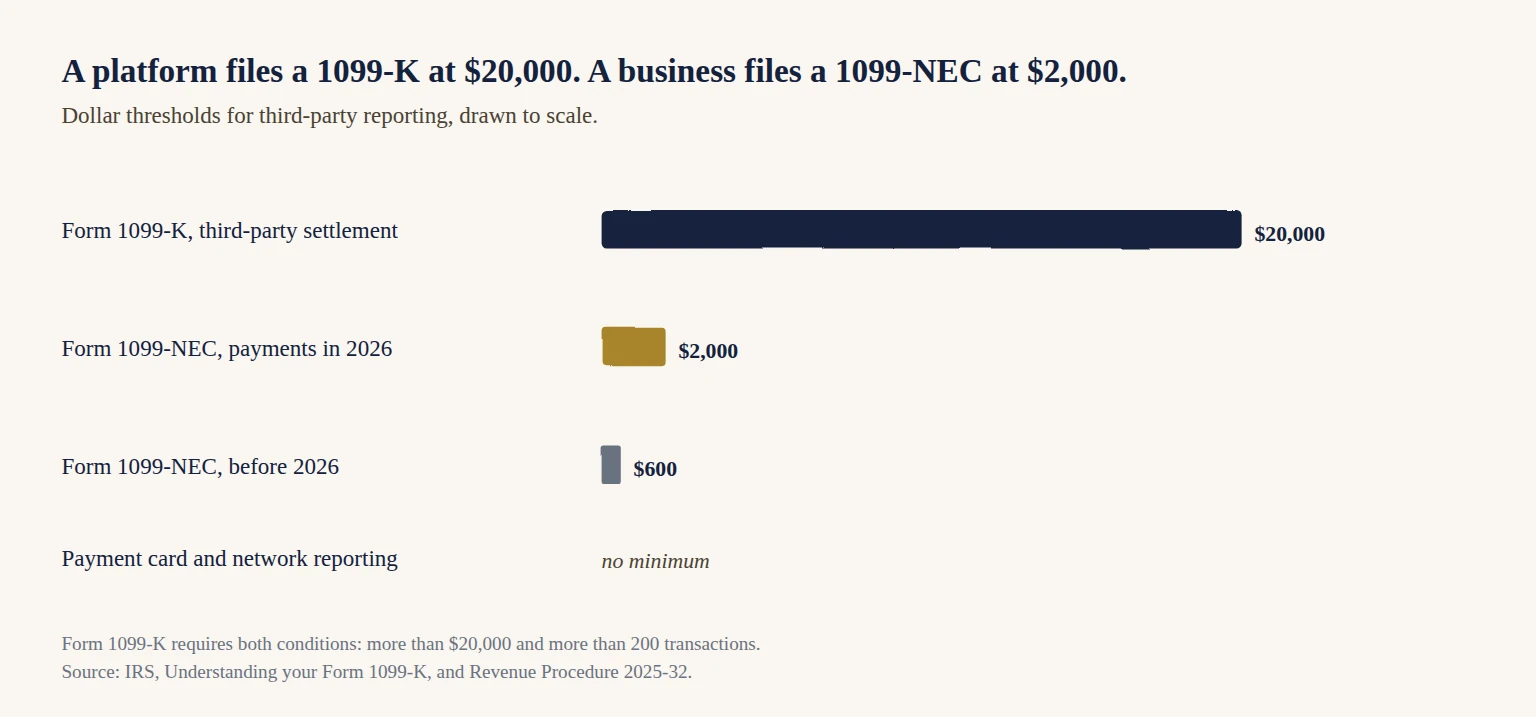
The threshold for most reportable nonemployee service payments rises to $2,000 for payments made in 2026, replacing the prior $600 threshold. Exceptions and separate reporting categories still exist. Business owners should collect contractor tax information and check the applicable rules rather than applying one threshold to every payment.
Neither change creates a tax-free income allowance. Reconcile bank deposits, platform records, and Form 1099-NEC or Form 1099-K statements. Report taxable business income even when no form arrives, and avoid counting the same receipt twice.
Which other OBBBA changes deserve a year-end check?
A qualifying personal vehicle loan may generate an interest deduction of up to $10,000 for tax years 2025 through 2028. Phaseouts begin above modified adjusted gross income of $100,000, or $200,000 jointly. New-vehicle, loan-date, U.S. final-assembly, and other requirements apply; used cars and leases do not qualify.
Energy-credit timing also changed. The IRS says the residential clean energy credit does not apply to expenditures after December 31, 2025, and the energy-efficient home improvement credit does not apply to property placed in service after that date. Do not budget for a 2026 credit using an older sales brochure.
The federal scholarship donation credit begins in 2027, not 2026. State participation announcements do not create a current-year deduction or credit automatically.
What should Dallas-Fort Worth taxpayers do now?
Texas has no personal state income tax, but federal obligations remain. Self-employed residents should review income and estimated payments using their actual business records.
Business entities should also check Texas obligations separately. Federal deductions do not remove franchise tax responsibilities. See our Texas franchise tax guide and confirm your entity's requirements with the Texas Comptroller.
Gather current pay statements, dependent information, and business records before making year-end decisions. Contact ArmStrong Tax & Consulting to discuss which provisions need a closer review for your household or business.
Which sources support this guide?
Figures and effective dates were checked against IRS materials on October 18, 2026. Principal sources are the linked IRS inflation announcement, Revenue Procedure 2025-32, the IRS individuals-and-workers provisions page, Publication 6079, the Form 1099-K guidance, and the IRS Working Families Tax Cuts overview. The Texas Comptroller provides state business-tax guidance. Full URLs appear in this article's source metadata.
Eligibility depends on your income, filing status, and records.
Frequently asked questions
- Do these changes apply to returns filed in 2026?
- This guide covers tax year 2026, generally reported on returns filed in 2027. A return for 2025 filed during 2026 uses 2025 amounts.
- Can I deduct tips or overtime while taking the standard deduction?
- Yes, eligible taxpayers may claim these deductions without itemizing. Income limits, qualifying compensation rules, Social Security number requirements, and joint filing requirements for married taxpayers apply.
- Does the higher Form 1099-K threshold make my side income tax-free?
- No. The threshold governs platform reporting, not whether business income is taxable. Report taxable income even if no form arrives.
- Does Texas's lack of a personal income tax eliminate my filing obligations?
- No. Federal income and self-employment taxes can still apply. Texas businesses may also have franchise tax, sales tax, and information-reporting obligations.
Ask a general tax question
Use the tax information chat for general educational questions. Discuss your own situation with a professional before relying on an answer.
Book a free 15-minute intro call
Pick a time on Okeyma's calendar. The introductory call is for discussing your needs and learning about our services. Tax and notice reviews are paid services.
Related reading

How to Choose a CPA or Tax Preparer in Fort Worth & Southlake
Picking tax help in Fort Worth or Southlake? The credentials that matter, 7 questions to ask, red flags, and what to bring to your first meeting.
· 6 min read

CPA vs Tax Preparer: Who Do You Actually Need?
A CPA, an Enrolled Agent, and a tax preparer can all file your return. What each one does, what each costs, and when you actually need the credential, plainly explained.
· 5 min read

How an LLC Files Taxes (Every Setup Explained)
An LLC has no tax form of its own: classification decides how you file. Forms, deadlines, and the Texas angle for all three setups.
· 5 min read