

Editorial Information
- Tax year:
- 2026
- Reviewed by:
- Okeyma Armstrong, ArmStrong Tax & Consulting
- Last reviewed:
- November 14, 2026
- Jurisdictions:
- United States, Texas
Sources
- https://comptroller.texas.gov/taxes/franchise/
- https://comptroller.texas.gov/taxes/franchise/filing-requirements.php
- https://comptroller.texas.gov/taxes/publications/98-806.php
- https://comptroller.texas.gov/taxes/franchise/pir-oir-filing-req.php
- https://comptroller.texas.gov/taxes/franchise/ntd-rpt-updates-2024.php
- https://comptroller.texas.gov/taxes/franchise/filing-extensions.php
- https://comptroller.texas.gov/taxes/sales/
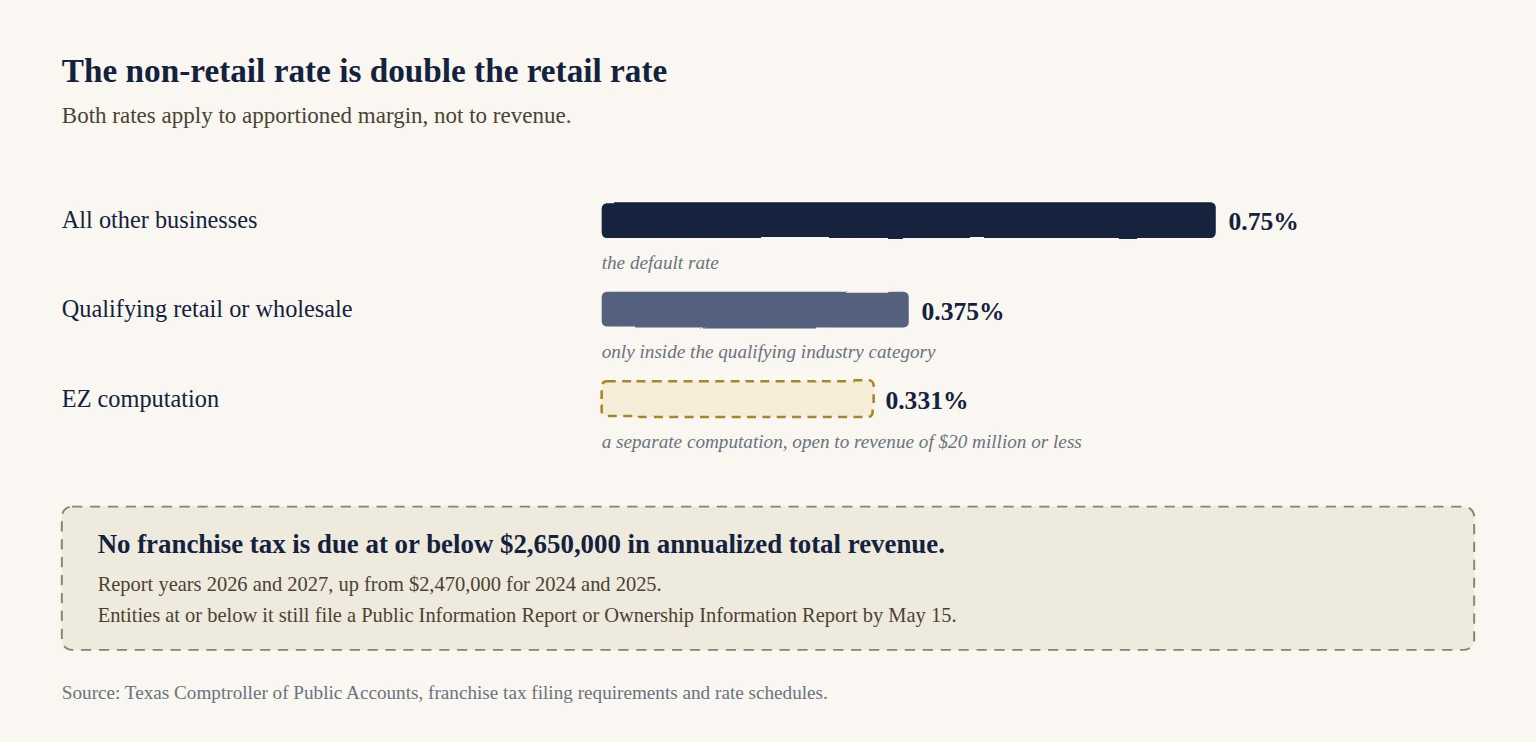
For Texas franchise tax report years 2026 and 2027, a taxable entity owes no franchise tax if its annualized total revenue is $2,650,000 or less. Most entities below that threshold still must file a Public Information Report or Ownership Information Report by May 15 each year.
Check two questions separately: does the business owe tax, and which reports does it still need to file?
| Figure | 2026 and 2027 report years | 2024 and 2025 report years |
|---|---|---|
| No-tax-due threshold (annualized total revenue) | $2,650,000 | $2,470,000 |
| Tax rate, qualifying retail or wholesale | 0.375% | 0.375% |
| Tax rate, all other businesses | 0.75% | 0.75% |
| Compensation deduction limit, per person | $480,000 | $450,000 |
| EZ computation rate | 0.331% | 0.331% |
| EZ computation revenue cap | $20 million | $20 million |
| Annual report deadline | May 15 | May 15 |
What is the Texas franchise tax?
The Texas franchise tax is a privilege tax on most entities formed in Texas or doing business in Texas, including LLCs and corporations. It is charged on margin, not profit, so net income is not where the calculation starts.
A taxable entity is a legal entity, such as an LLC, corporation, or partnership, that is formed in Texas or does business in Texas and is not exempt from the tax. Margin is the part of an entity's total revenue that the tax rate is applied to, found by taking the lowest of four statutory computations. The calculation section below walks through all four.
Out-of-state businesses can be subject too. A company formed in another state that has Texas activity can be a taxable entity here, so the state of formation does not settle the question by itself.
The Texas Comptroller of Public Accounts administers the tax, and its franchise tax page holds the current forms and instructions. For how it fits with the rest of an LLC's yearly filings, see our overview of how LLCs file business taxes.
Who has to pay Texas franchise tax?
Most Texas LLCs and corporations are taxable entities. The list includes single-member LLCs, corporations, S corporations, professional corporations, banks, savings and loan associations, partnerships (general, limited, and limited liability), trusts, professional associations, joint ventures, and other legal entities.
A federal S election does not remove a business from Texas franchise tax. Neither does disregarded-entity status. A single-member LLC that the IRS ignores for income tax purposes is still a separate taxable entity in Texas. Owners miss this often, because the federal return shows nothing for the LLC.
Who is not subject to the tax?
Four groups are generally outside the tax:
- Sole proprietorships that are not organized as LLCs.
- General partnerships owned entirely by natural persons, unless the partnership is a limited liability partnership.
- Entities exempt under Tax Code Chapter 171, Subchapter B.
- Certain unincorporated passive entities.
Passive entities
The passive-entity rule needs care. A passive entity is not subject to the tax only when its income comes entirely from passive sources, such as interest, dividends, royalties, rents (unless the rents come from an active trade or business), and gains from property sales. One active income stream changes the answer.
Two situations still lead to a filing. A passive entity that has lost its qualification is a taxable entity again. A taxable entity with zero Texas gross receipts also still files a report. Passive entities that must file use the EZ computation or the Long Form, and for them the report asks only for entity information, dates, and a signature.
When you are unsure which group you fall into, the Comptroller's filing requirements page is the place to confirm before you assume you are exempt.
What is the no-tax-due threshold for 2026 and 2027?
The no-tax-due threshold for report years 2026 and 2027 is $2,650,000 in annualized total revenue, and it tests revenue, not profit. A business with thin margins and $3,000,000 in revenue is above the line. A highly profitable business with $2,000,000 in revenue is below it.
The no-tax-due threshold is the annualized total revenue amount at or below which a taxable entity owes no franchise tax for a report year. Several mechanics sit behind that sentence.
- Total revenue. It comes from the entity's federal income tax reporting, then is reduced by statutory exclusions. Revenue that does not count under those exclusions does not count toward the threshold.
- Annualization. If the first accounting period is shorter than a year, the revenue must be annualized before it is tested. A new LLC that earned $400,000 over three months is tested as if that pace ran for twelve months.
- Report year versus income year. The report year is the year the report is due. The income year is the accounting period the numbers come from. A 2026 report generally covers an accounting period that ended in 2025.
- Figures for the right year. The threshold is tested per report year, using that report year's figure. The table above shows why mixing years causes mistakes. The threshold for report years 2024 and 2025 was $2,470,000, and the figure for report years 2026 and 2027 is $2,650,000.
An entity near the line should work the numbers carefully. A few thousand dollars of excluded revenue can decide whether the report shows a tax bill.
What do you file if you owe no tax?
An entity at or below the threshold files Form 05-102, the Public Information Report, or Form 05-167, the Ownership Information Report. The standalone No Tax Due Report was discontinued for 2024 and later report years.
A Public Information Report is the annual form that reports an entity's management and registration details, and that information appears in the public Taxable Entity Search. Which form applies depends on the entity type:
- Public Information Report (05-102): corporations, LLCs, limited partnerships, professional associations, and financial institutions. The data flows to the Secretary of State.
- Ownership Information Report (05-167): other taxable entities. The ownership information stays confidential.
Both are due on the same May 15 deadline as the tax report. An officer, director, owner, or other authorized person signs the report. The Comptroller's PIR and OIR filing requirements page lists the details.
Skipping the information report has real consequences. The entity risks forfeiture of its right to transact business in Texas. A forfeited entity cannot sue or defend in Texas courts, and its owners can become personally liable for certain debts. The cost of filing is small next to those outcomes.
Combined groups have one extra rule. If the group is at or below the threshold, no group report is filed. Each Texas member still files its own Public Information Report or Ownership Information Report.
Qualifying new veteran-owned businesses are not required to file the information reports during their initial five-year period.
How is Texas franchise tax calculated?
Texas franchise tax equals apportioned margin multiplied by the rate, and margin is the lowest of four computations. The four options are:
- Total revenue multiplied by 70%.
- Total revenue minus cost of goods sold.
- Total revenue minus compensation.
- Total revenue minus $1 million.
The entity picks whichever produces the lowest margin, and a combined group must use the same margin method for all members.
Each option has its own conditions:
- Cost of goods sold generally applies to businesses that sell goods or real property. A pure service business typically does not have it.
- Compensation means W-2 wages and cash compensation, including net distributive income to natural-person owners. It is capped at $480,000 per person for report years 2026 and 2027. It also includes benefits such as workers' compensation, health care, and retirement, to the extent they are federally deductible. Payments to 1099 contractors and employer payroll taxes do not count.
Margin is then apportioned to Texas using a single gross-receipts factor. Texas gross receipts divided by gross receipts everywhere gives the share of margin that is taxed. An entity with all receipts from Texas customers apportions at 100%.
The rate for report years 2026 and 2027 is 0.375% for qualifying retail or wholesale businesses and 0.75% for all other businesses.
A worked example
Take a standalone service business with $3,000,000 in total revenue, all receipts in Texas, and no credits.
- The 70% method gives margin of $2,100,000.
- Revenue minus $1 million gives margin of $2,000,000.
- The second figure is lower, so margin is $2,000,000.
At the 0.75% rate for report years 2026 and 2027, the regular-method tax is $2,000,000 x 0.75%, or $15,000.
The result is not $15,750. That figure comes from using the 70% method alone, without comparing the lower $1 million deduction. This is the most common arithmetic slip on a first franchise tax report, and it overstates the bill by $750 here.
If you want help comparing the methods on your own numbers, our business tax services cover franchise tax reports as part of annual filing work.
What is the EZ computation and when does it beat the regular method?
The EZ computation taxes apportioned total revenue at 0.331% for entities, or combined groups, with $20 million or less in annualized total revenue. It skips the margin methods entirely.
The trade is straightforward. An entity that files EZ gives up the margin deductions, meaning cost of goods sold and compensation. It also gives up all credits, including carrying over that year's temporary credit for business loss carryforward. The EZ rate applies to revenue with no deductions, which is why it is a lower rate than the regular one.
Continue the $3,000,000 example from above, with all receipts in Texas. The EZ tax is $3,000,000 x 0.331%, or $9,930. That beats the regular-method tax of $15,000. For a service business with no large cost of goods sold or compensation deduction, EZ usually wins.
A business with heavy payroll can see a different result. Suppose compensation brings margin well below $2,000,000. The long form at 0.75% could then come out lower than $9,930. A retail or wholesale business at 0.375% can also land below the EZ figure when its margin is small relative to revenue.
The lowest headline rate does not decide it, so run both. The comparison takes minutes and can change the bill by thousands of dollars.
When is the Texas franchise tax due?
The Texas franchise tax is due May 15 each year, moved to the next business day when May 15 falls on a weekend or legal holiday. The same deadline applies to information reports as well as to the tax report and payment.
New entities get their own timing. A new entity's first annual report is generally due the year after it becomes subject to the tax. An entity formed in 2026 reports for the first time in 2027. You do not wait for a full calendar year of operations before the first report comes due.
An extension of time to file exists, but the request is timely only if it is received on or before the due date, and a valid extension generally also requires paying 100 percent of the prior year's tax or 90 percent of the current year's tax by that date. Decide early if the numbers are not ready.
Final reports follow their own timing. That covers termination, conversion, merger, and ending Texas nexus. Check the Comptroller's instructions before assuming May 15 applies to a final report.
Mark the date on your calendar once a year alongside the rest of your recurring filings. Our small-business tax checklist lists those dates in one place.
What happens if you file or pay late?
A late franchise tax report carries a $50 penalty. Tax paid 1 to 30 days late adds a 5% penalty, and tax paid more than 30 days late adds 10%. Interest starts 61 days after the due date.
The $50 penalty applies even when no tax is due, so a missed information report still costs money. Ongoing non-filing leads to forfeiture proceedings, which is the larger problem. A forfeited entity loses its right to transact business in Texas, and the consequences described earlier follow.
Reinstatement is also more work than most owners expect. Reinstatement means fixing every outstanding year, not just the newest notice. An entity that skipped three years of reports has to resolve all three.
Owing no tax does not make a notice safe to ignore. A notice about a missing Public Information Report or Ownership Information Report starts the same forfeiture clock as a notice about unpaid tax. If you have a franchise tax notice in hand, the firm's notice-handling page covers next steps.
How is franchise tax different from Texas sales tax?
Franchise tax is a privilege tax the business itself pays on its margin. Sales tax is collected from customers on taxable transactions and passed along to the state. The business owes the first because it exists as an entity. It owes the second only if it sells taxable goods or services.
Texas sales tax is 6.25% at the state level plus up to 2% local, for a maximum of 8.25%. It requires a sales tax permit, and returns are filed monthly, quarterly, or annually on the 20th. A business can owe franchise tax, sales tax, both, or neither, because the two turn on different triggers. Our companion guide to Texas sales tax covers permits and filing frequency. The Comptroller's sales tax page has the official rules.
What to check next
Four facts decide almost everything in this article:
- Your report year.
- Your accounting period.
- Your annualized total revenue.
- Your entity classification.
With those in hand, you can read the table above, pick the right row, and see whether you owe tax or only a report. The 2026 Texas tax roadmap lays out the other Texas dates for the year. If the numbers are close to a threshold or a notice has already arrived, contact the firm with your report year and entity type.
Frequently asked questions
- Do sole proprietors pay Texas franchise tax?
- A sole proprietorship that is not organized as an LLC generally is not a taxable entity. A single-member LLC generally is a taxable entity, even when it is disregarded for federal income tax purposes.
- What is the no-tax-due threshold for 2026?
- $2,650,000 in annualized total revenue for report years 2026 and 2027. Use the threshold for the report year, and check annualization if the accounting period is shorter than a year.
- Does an LLC below the threshold still file a report?
- Generally, it must file a Public Information Report or Ownership Information Report. For 2024 and later report years, entities at or below the threshold do not file a franchise tax report merely to report no tax due. Special entity rules can apply.
- When is a new entity's first annual report due?
- Generally, May 15 of the year after the entity becomes subject to franchise tax, adjusted for weekends and holidays. Do not assume you can wait for a full calendar year of business operations.
- What is the Texas franchise tax rate for 2026?
- 0.375% for qualifying wholesale and retail businesses and 0.75% for all others, applied to apportioned margin. The EZ computation rate is 0.331% for entities with $20 million or less in total revenue.
- Is Texas franchise tax the same as sales tax?
- No. Franchise tax is a privilege tax the business itself pays on its margin. Sales tax is collected from customers on taxable sales of goods and services and filed under a separate permit.
Ask a general tax question
Use the tax information chat for general educational questions. Discuss your own situation with a professional before relying on an answer.
Book a free 15-minute intro call
Pick a time on Okeyma's calendar. The introductory call is for discussing your needs and learning about our services. Tax and notice reviews are paid services.
Related reading

How an LLC Files Taxes (Every Setup Explained)
An LLC has no tax form of its own: classification decides how you file. Forms, deadlines, and the Texas angle for all three setups.
· 5 min read

Small Business Tax Preparation Checklist (2026)
Everything to gather before your small business return: income records, expenses, entity forms, payroll items, and Texas filings, one working checklist.
· 6 min read

How to Choose a CPA or Tax Preparer in Fort Worth & Southlake
Picking tax help in Fort Worth or Southlake? The credentials that matter, 7 questions to ask, red flags, and what to bring to your first meeting.
· 6 min read